COLLEEN CARROLL
Can a new website improve client and employee experience?
Brussels Business Flats, better known as BBF, is a real estate company specialized in short term accommodation. They offer fully furnished, serviced rental apartments with flexible contracts. A family owned company, BBF has expanded from one property to more than 35 properties since opening their first rental property in 1992.
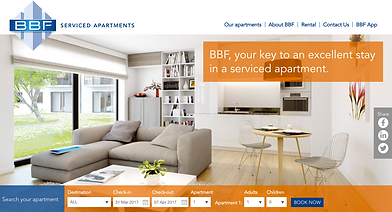
BBF decided to rebuild their web services. They contracted a software developer to design and build a new company website, a mobile app for employees to execute tasks at building sites, and an app for tenants and customers.
BBF had a strong vision for their company but was unclear on how to ensure their new web platforms would tackle all three challenges. I was hired to accomplish three tasks:
-
to execute research to better understand the key criteria necessary to provide a better web experience for BBF’s customers
-
to execute research to better understand the key criteria for employees to better address incoming information requests
-
to write copy for all website and application pages
BBF faced three key problems:
-
First, potential clients lacked access to information about BBF’s products.
-
Second, employees were overwhelmed with requests for information. Responding to these requests consumed more than 75% of their work day and led to impersonal, cookie-cutter responses that did not project the company’s focus on personalized service.
-
Third, local events threatened to deter expats and visitors from traveling to Brussels. BBF needed to better address incoming requests to ensure occupancy levels were sustainable.
Project
Process
RESEARCH
Plan
With a cross-functional team of BBF employees, we held a mind mapping sessions to categorize user needs. These categories stemmed from the needs id’d during our journey mapping and survey exercises. We filled a meeting room with sticky notes that held comments from each exercise. Team members were invited to pass through the room over the course of 3 days and to group or organize notes into categories. At the end of the 3-day period, we brought the group together to discuss the results and clarify category headings. We were able to map needs identified in each category specific to activities users needed to execute, a core component for our requirements document.
Three key types of users surfaced: the casual traveler, the young professional, the seasoned business traveler. We flushed out the digital journey each persona experienced, which led us to a seriers of design criteria imperative to improving his or her experience.
We followed suit for BBF employees. Observing their days and interactions helped us map their digital journeys. Decision-making patterns were similar across BBF's three offices and across functionality levels, which helped us create a list of critical issues universal to the company's staff.
Journey Mapping
-
Use remote testing tools to follow users as they search for information on the website.
-
Participants for journey mapping and usability testing were recruited through relocators. Though relocators typically coordinate housing for their colleagues travelling to new work locations, employees scheduled for assignments abroad could walk us through the information they frequently sought when looking for accommodation abroad. BBF held strong, long-standing relationships with recruiters. This meant a.) quick access to participants, as relocators were happy to help BBF improve their product, and b.) participants somewhat familiar with BBF’s market, who could accurately compare the current website to their experience using websites for similar products.
-
10 users walked me through their experience using the website. As they surfed, I asked them to explain:
-
What action they wanted to complete on each page
-
What questions arose in their mind as the read through the page
-
What happy moments they encountered on the page
-
What pain points they encountered
-
Surveys
-
The survey questioned tenants’ experience in finding BBF, acquiring accurate information to guide their decision, and the process for making a booking.
-
The survey used Likert scales to clarify the needs that emerged in our Journey Maps
-
More than 350 tenants responded to the survey.
Ethnographic STudy
-
Observed BBF employees over the course of three days
-
Analyzed interaction with software, mobile technology, and other mechanisms to break down key elements of job execution
Synthesize
Ideate
Write
We designed a three-tiered research strategy to uncover the criteria most important for BBF's customers and the criteria employees needed to more efficiently manage their workload.
The overarching goal was to create a list of key features our web developers could build out into BBF's new, user friendly website and mobile app.
The personas that emerged in synthesis led us to a set of design criteria, and the design criteria prompted us to propose features that meet these criteria.
-
Integrated maps would help potential tenants get a feel for the neighborhood where they would reside.
-
A tablet-based app would help account managers quickly perform apartment inspections, freeing up time for personalized customer service.
-
The standing BBF website required customers to call or email BBF staff to inquire about availability, but customers- private clients and professional relocation staff- wanted immediate indications of availability. They relished integrated search options similar to web-based travel booking companies and search engines.
-
Many tenants only had time to address apartment-related issues after working hours or on the weekends while BBF's offices are closed. Requests to extend a lease, for more information, or for repairs were often buried in BBF staff members' email inboxes, as BBF staff members were receiving an average of 113 email requests per day. We proposed an online portal for all BBF apartment contract holders. This site would:
-
Allow access to monthly invoices
-
Provide a Request for Service Form, to ask for repairs or cleaning services
-
Provide detailed information on the apartment's and building's amenities and inventories
-
Include practical details for the surrounding areas and cultural guides, including a list of nearby transportation links (and tips for using public transport), local markets and grocery stores, nearby restaurants and museums
-
A personalized calendar that includes contract termination dates, dates for scheduled cleaning of the apartment and common areas, and key local holidays
-
Several texts came out of this project:
-
We drafted a requirements document package for our web developers. This included:
-
Key problem statements for employees and clients
-
A sitemap
-
A list of functionalities and their hierarchy for BBF and client users
-
Lo-fi wireframes/mockups
-
-
As a copywriter, I crafted written content for new pages and the user portal
-
I proofread and improved previous texts to match BBF's brand identity and message.